Downtown's Hidden History: The Vanished Gateway District
Walk through downtown Minneapolis today and you'd never guess it was once a bustling, rough-and-tumble hub for laborers, immigrants, and dreamers. Let's dig into the vanished Gateway District.
Dave Kowalski — Columbia Heights
Retired Fridley history teacher, third-generation Northeast, obsessed with the Minneapolis streetcar system and working-class neighborhood history.
Hey folks, Dave Kowalski here, writing from my cozy corner in Columbia Heights. You know, sometimes I'm walking through downtown Minneapolis, maybe heading to a meeting or just grabbing a coffee, and I look at all the glass towers and busy sidewalks, and I think about what’s *not* there anymore. Because, here's the thing: the ground you’re walking on? It's often got layers of history buried right beneath your feet, and nowhere is that more true than in a little-known, or maybe I should say, *unseen*, part of downtown that used to be called the Gateway District.
What most people don't know is that the polished, corporate heart of Minneapolis, roughly bounded by the Mississippi River, Washington Avenue, and Hennepin and Nicollet Avenues, was once a completely different beast. Forget your fancy restaurants and boutique shops. This area, back in its heyday, was the gritty, beating heart of working-class Minneapolis. It was a place for dreamers, for drifters, for the newly arrived, and for anyone who needed a cheap bed and a strong cup of joe after a long day.
The Original Gateway: A Place for the Working Man (and Woman)
Picture this: it’s the late 19th and early 20th century. Minneapolis is booming, thanks to flour mills and lumber. Thousands of men – lumberjacks, railroad workers, transient laborers – are pouring into the city, looking for work and a place to lay their heads. And they all gravitated to what was then known as the Gateway District.
This wasn't some quaint historical village, mind you. This was the city’s original skid row, but don't let that term fool you into thinking it was just a den of despair. It was a bustling, vibrant, sometimes chaotic place. Washington Avenue, running east-west, was the main artery, absolutely packed with businesses catering to the working class. We're talking dozens of cheap hotels, often called 'nickel-a-night' flophouses, but also more respectable rooming houses for those with a steady paycheck. There were saloons on practically every corner, union halls thrumming with activity, employment agencies, pawn shops, second-hand stores, and missions offering soup and sermons.
It was the arrival point for countless immigrants too. Swedes, Norwegians, Germans, Irish – they all passed through the Gateway, picking up English, finding their first jobs, and sending money home. It was rough around the edges, sure, but it was also a place of opportunity, a place where solidarity was forged in the union halls, and where many a Minnesota story began.
More Than Just Buildings: The Pulse of a People
Here's a fun fact: the iconic triangular plot of land where Hennepin, Nicollet, and Washington Avenues converge – what you might know today as a small park or just a busy intersection – was once home to the original Gateway Building, a beautiful, ornate structure that truly lived up to the 'gateway' moniker. It was torn down, like so much else, but it was a symbol of this vibrant hub.
The district wasn't just a collection of buildings; it was a living, breathing ecosystem of people. You’d see hardened lumberjacks fresh from the northern woods, still smelling of pine and sweat, rubbing shoulders with newly arrived immigrants clutching their meager possessions. Social workers, reformers, and even early women’s rights advocates worked in the area, trying to improve conditions or offer aid. This was where the city grappled with its growing pains, where the contrasts of wealth and poverty were starkest.
The “Progress” that Erased a Past
So, what happened to this bustling, working-class heart of the city? Well, by the mid-20th century, the Gateway District was starting to look a bit, shall we say, ‘outdated’ in the eyes of city planners and powerful businessmen. It was still filled with old buildings, many of them in disrepair, and it didn't fit the shiny, modern image Minneapolis wanted to project.
Beginning in the late 1950s and extending into the 1960s, the city embarked on one of the most ambitious urban renewal projects in American history. What most people don't know is the sheer scale of it: over 40% of downtown Minneapolis was demolished. Nearly 200 buildings, many of them historic, were simply wiped off the map. Thousands of residents, mostly low-income and elderly, were displaced. The goal was to clear out what was seen as “slums” and replace them with modern office buildings, parking ramps, and green spaces.
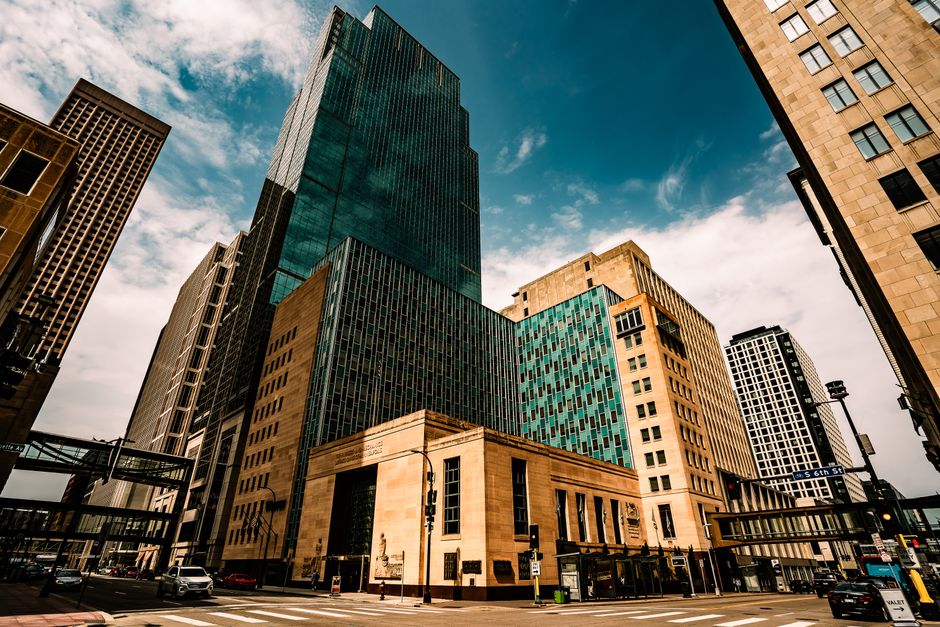
The area around Marquette Avenue and 2nd Avenue South, which today is full of sleek high-rises, was once a dense network of residential hotels and small businesses. Imagine trying to find a cheap room there now! It’s almost impossible to reconcile the two images.
Glimmers of What Was
Today, if you walk through that part of downtown, it's hard to find much evidence of the old Gateway. The triangular Gateway Park at Hennepin/Washington/Nicollet is still there, now a more manicured green space, but the original building that gave it its name is long gone. The impressive Milwaukee Road Depot (at 201 3rd Avenue South), built in 1899, survived the wrecking ball and is now a hotel and event center – a fantastic example of adaptive reuse and one of the last true architectural links to the Gateway's past.
Another survivor is the original Minneapolis Public Library building (now a municipal office building at 1001 Hennepin Avenue, just outside the core demolition zone but historically serving the area). Even these few remaining structures feel almost out of place, dwarfed by their newer neighbors.
Here's the thing about history: you can tear down the buildings, but you can’t completely erase the stories. Every time I walk past the modern high-rises, I can almost hear the echoes of the lumberjacks and the immigrants, the clatter of horse-drawn carts, and the lively chatter from a hundred different saloons and union halls. It’s a reminder that every city has a ghost, and Minneapolis’s most significant ghost is undoubtedly its vanished Gateway District, a testament to the working people who built this city, brick by brick, dream by dream.
Enjoying this? Get Minnesorta in your inbox every week — no fluff, just good Twin Cities stuff.
Photo by Roy Serafin on Pexels


